Q3 2022: Fastest growing sectors in the Nigerian economy
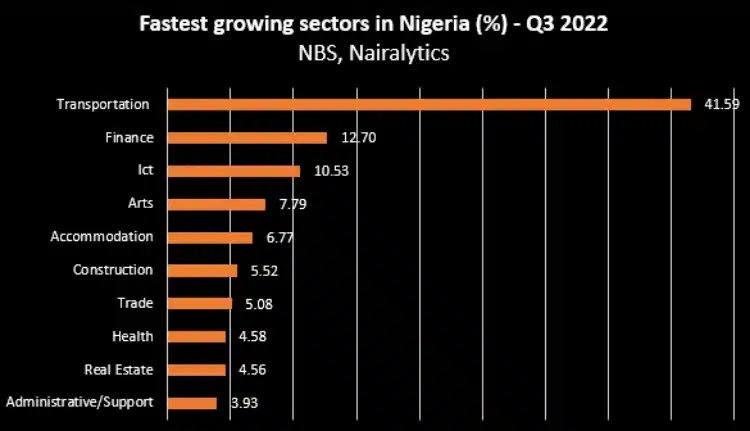
The transportation and financial sectors in Nigeria, which recorded genuine growth rates of 41.59% and 12.7%, respectively, were the leaders among the swiftly expanding sectors in the third quarter of 2022.
This information is detailed in the Q3 2022 Gross Domestic Product (GDP) report by the National Bureau of Statistics (NBS).
In Q3 2022, Nigeria’s economy grew by 2.25% in real terms compared to the prior year, primarily due to advancements in the non-oil sector. However, growth was slower than the previous quarter (3.54%) because of regional and global constraints.
Out of nineteen sectors, four experienced contractions, while fifteen demonstrated positive year-over-year growth in extensive sectoral breakdowns. During this period, negative growth was observed in manufacturing (1.91%), other services (2.67%), electricity (3.56%), and mining and quarrying (21.31%).
Sectors facing recession:
An economy is considered to be in a recession when the overall GDP decreases for two successive quarters. In the broad sectoral classification, merely two sectors are still in recession. These are:
The provision of electricity, gas, steam, and air conditioning experienced a 3.56% drop in GDP, following declines of 11.48% in Q2 2022 and 11.2% in Q1 2022. Despite showcasing remarkable growth percentages in the previous year, this sector has continued to experience negative growth for three consecutive quarters.
After an 11.09% contraction in the preceding quarter, the mining and quarrying sector observed a 21.31% reduction in the period under review. The decline in crude oil and natural gas sectors has significantly influenced this sector’s downward trajectory since Q2 2020.
The Nigerian oil sector has been affected by the volatile global crude oil market as well as its inability to function at full capacity due to issues such as oil theft, vandalism, insecurity, and capital flight.
The oil refining subsector was among those that indicated a decline in Q3 2022, registering a drop of 44.7% following a decline of 42.12% in Q2 2022. Rail transportation, pipeline, textiles, apparel, footwear, and other industries all exhibited negative GDP growth for at least two consecutive quarters.
The fastest-growing sectors in Nigeria’s economy for Q3 2022 are enumerated below:
Transport and storage (41.59%): The transportation and storage sector of Nigeria’s economy grew by 41.59% in the third quarter of 2022, making it the most rapidly expanding sector in the nation’s largest economy. However, it expanded at a slower rate than the previous quarter due to declines in the pipeline and rail transportation subsectors.
According to the breakdown, road transport, which accounts for 83.6% of the entire sector, progressed by 49.68% year over year, a decrease from the 56.38% noted in Q2 2022 but an increase from the 21.11% observed during the same period in 2021.
In contrast to Q2 2022, when the water transport subsector expanded by 3.02%, it grew by 19.48% in Q3 2022.
Air travel surged by 14.58%, while transportation services grew by 6.66%, and postal and courier services expanded by 5.36% year over year in real terms.
Finance and insurance (12.7%):
The financial and insurance sector experienced a growth rate of 12.7% year over year in real terms during the third quarter, a slower pace compared to the 18.48% growth reported in the second quarter and the 23.24% growth experienced in Q1 2022.
With an estimated quarterly income of N660.8 billion and a projected total annual revenue of N2.9 trillion, the sector constitutes 3.49% of the national economy.
Roughly 90% of the sector consists of the financial subsector, which increased by 12.03% year over year from the 20.06% noted in the previous quarter. Conversely, the insurance subsector saw growth of 19.09% year over year, surpassing the 6.96% recorded in the prior quarter.
Information and communication (10.53%): The ICT sector growth improved to 10.53% year-over-year in Q3 2022 from 6.55% in the previous quarter. The information and communication sector generates 15.4% of the nation’s GDP.
The telecommunications sector, which includes some of the largest companies in the country and comprises 83.7% of the ICT sector, increased by 10.53% year over year from 6.55% in the previous quarter.
Compared to the 3.43% growth observed in Q2 2022, the Publishing subsector recorded a 12.06% increase during the quarter under review. While broadcasting reported a 6.58% year-over-year growth, the film, sound recording, and music industries all achieved a 22.41% growth.
Other sectors include
Arts, entertainment, and recreation – 7.79%
Accommodation and food services – 6.77%
Construction – 5.52%
Trade – 5.08%
Human health and social services – 4.58%
Real estate – 4.56%
Administrative and support services
Key Points to Note:
In the third quarter of 2022, Nigeria’s gross domestic product (GDP) increased by 2.25% year over year in real terms, a decline from the 3.54% growth observed in the previous quarter.
Agriculture rose from 23.24% in Q2 to 29.67% in real terms of Nigeria’s total GDP. Services composed 51.96 percent of the economy, while the industrial sector constituted 18.37%.
In Q3, the oil sector’s contribution to the real aggregate GDP diminished from the previous quarter’s 6.33% to 5.66%.
The non-oil sectors experienced an annual growth rate of 4.27%, which was 1.13% points lower than the corresponding period in 2021 and 0.50% points lower than Q2 2022. Despite this, it saw increases of 0.67% and 1.83%, respectively, quarter over quarter and year over year, concerning its share of contribution to real aggregate GDP.