

Nigerians executed N12.8 trillion in mobile transactions from January to September 2022, more than doubling the figure recorded during the same timeframe last year and significantly surpassing what was noted in 2020.
Evidence from the Nigeria Inter-Bank Settlement System (NIBSS) for the years 2018 to 2022 verifies this trend. The NIBSS indicates that in the initial nine months of 2022, mobile inter-scheme transactions recorded in Nigeria surged by an astonishing 153% year-on-year from the N5.07 trillion noted in the equivalent period of 2021. When juxtaposed with the same timeframe in 2020 (N1.89 trillion), 2019 (N461.4 billion), and 2018, the total transaction volume for the current year exemplifies an even more considerable increase (N216.4 billion).
Since the COVID-19 outbreak, which necessitated the adoption of more cashless payment methods nationwide, mobile and digital banking have gained significant popularity. A detailed analysis of the data gathered by the NIBSS uncovered that during the evaluation period, the volume of mobile transactions rose by over 132%.
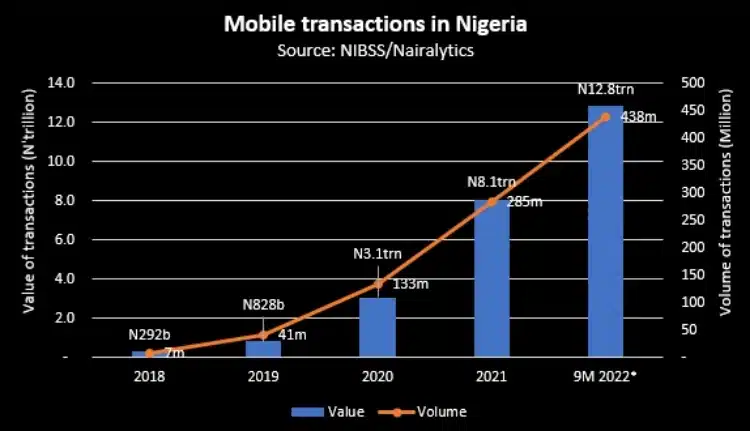
Specifically, more than twice the number of mobile transactions (438.28 million) were recorded compared to 2021 (284.5 million). The amount processed via POS transactions in the initial nine months of the year reached N6.05 trillion, slightly lower than the N6.4 trillion noted for the entire year of 2021, with three months still remaining.
The primary beneficiaries are banks and telecoms
Nigeria’s commercial banks and telecommunications providers have reaped rewards from the utilization of mobile and various digital payment methods. This occurs as banks are charged for the majority of these transactions while telecoms gain from heightened data utilization.
The financial reports of the nation’s listed telecommunications firms displayed remarkable growth in data revenue. A substantial N549.2 billion was accrued from data for MTN Nigeria in the first nine months of the year, indicating a 50% rise from the N366.18 billion earned during the same timeframe in 2021.
In a similar vein, Airtel reported $431 million in earnings from their data sector between April and September 2022, a 22.8% growth from the $351 million derived during the same period the previous year.
Furthermore, banks have profited significantly from fees imposed on online banking transactions. FBN Holdings recorded N39.98 billion in e-banking revenue during the first nine months of the year, closely followed by Access Bank (N49.39 billion) and GTBank (N15.18 billion).
In Q4 2022, heightened spending is forecasted
Notably, mobile transactions in the nation may see further increases in the final quarter of the year, particularly during the festive season, which is characterized by celebrations and increased spending.
As Nigerians living abroad visited their families during this period, spending surged. A majority of purchases were made utilizing digital payment methods rather than traditional cash systems.
Meanwhile, the CBN has adopted a stringent monetary policy by hiking the cost of borrowing and withdrawing liquidity from circulation in reaction to the nation’s rising inflation rate. The total monetary supply as of September 2022 was N3.23 trillion, and the overall money supply nears N50 trillion.
Significance
The CBN’s Financial Inclusion strategy, which strives to significantly diminish the number of unbanked and underbanked individuals by advocating cash-less banking methods, aligns with the increasing utilization of mobile technology for transactions in the country.
Moreover, in a bid to enhance digital payments within the nation, the Central Bank launched the digital currency, eNaira, in 2021. According to the apex bank, this currency witnessed 200,000 users and N4 billion in transactions within just one year.
The CBN governor emphasized that the uptake of the digital currency would enhance Nigerians’ engagement in the digital economy and further promote financial inclusion.
