Nigeria Navy rank, symbols and Salary structure 2021 update
Nigeria Navy ranks, insignia and Salary framework 2021 revision
The Nigeria Navy is recognized as the most formidable in West Africa, as well as one of the most powerful across Africa, boasting significant human resources and being well-equipped.
They collaborate with other global partners to safeguard the Gulf of Guinea against maritime illicit activities, such as abduction, oil theft, piracy, marine ecological preservation, underwater combat, intelligence gathering, and territorial infringement.
The origins of the Nigeria Navy trace back to 1914 when it was referred to as the Nigerian Marine; it subsequently evolved into the Nigerian Naval Force.
In 1959, Queen Elizabeth II of England authorized Nigeria to adopt the title ‘Royal Nigerian Navy’; it was later modified to the Nigerian Navy in 1963 when the nation transitioned to a Republic.
Since then, it has made remarkable advancements.
You might be considering joining the Navy and wish to learn how to progress in rank to become one of the most distinguished officers in the Navy; this information is for you.
The Nigeria Navy, similar to the Police and other military institutions in the nation, has its own ranks, insignia, and salary framework.
Nigerian Navy ranks
The ranks within the Nigerian Navy are categorized into two separate tiers; they are:
Commissioned Officers
Non-Commissioned Officers
Commissioned Officers
These are personnel who entered the Navy via the Nigerian Defense Academy or the Direct Short Service Commission. Typically, they are university alumni holding a degree in any accredited field. They receive higher salaries than their non-commissioned counterparts and have a greater role in decision-making and leadership within the Nigeria Navy.
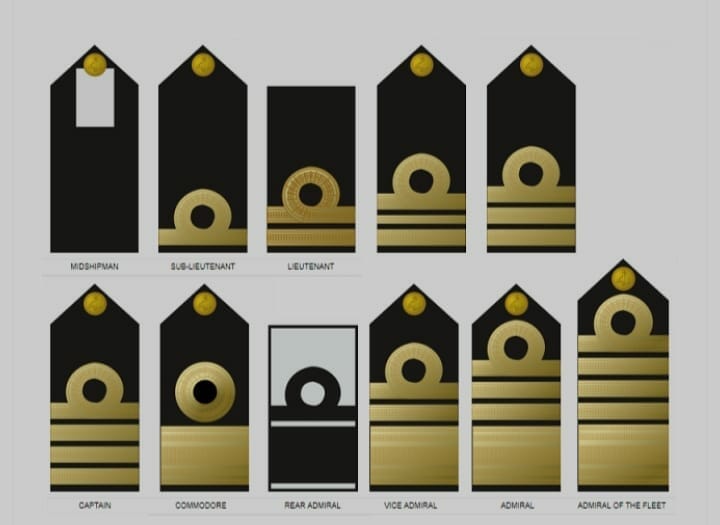
Below is the compilation of the commissioned officers;
Admiral of the Fleet
Admiral
Vice-Admiral
Rear Admiral Commodore
Captain
Commander
Lieutenant Commander
Lieutenant
Sub-Lieutenant
Acting Sub-Lieutenant
Mid-Shipman
Here are their insignia
Non-commissioned Officers
These individuals entered the Navy via the general enlistment process and are also referred to as the “ranks and file” of the naval service.
Below are the ranks of the non-commissioned officers in the Nigerian Navy
Warrant Chief Petty Officer
Chief Petty Officer
Petty Officer
Leading Rating
Able Rating
Ordinary Rating
Trainee
Non-commissioned officers do not possess badges.
Salary Framework
Members of the Nigeria Navy are compensated according to their ranks and educational qualifications; hence, the higher the level, the greater the remuneration. They also receive additional allowances for hazards.
For commissioned officers
Admiral of the Fleet
Admiral monthly income – N1,358,595 Vice Admiral monthly income – N1,113,602 Rear Admiral monthly income – N1,003,245. Commodore monthly income – N615,488. Captain monthly income – N309,654. Commander monthly income – N281,673. Lieutenant Commander monthly income – N230,652 Lieutenant monthly income – N195,685 Sub-Lieutenant monthly income – N150,625. Acting Sub-Lieutenant monthly income – N130,852. Mid-Shipman monthly income – N118,835
For Non-commissioned officers Warrant Chief Petty Officer monthly income – N120,853 Chief Petty Officer monthly income – N90,825. Petty Officer monthly income – N80,852. Leading Rating monthly income – N70,855. Able Rating monthly income – N50, 855. Ordinary Rating monthly income – N45,854